

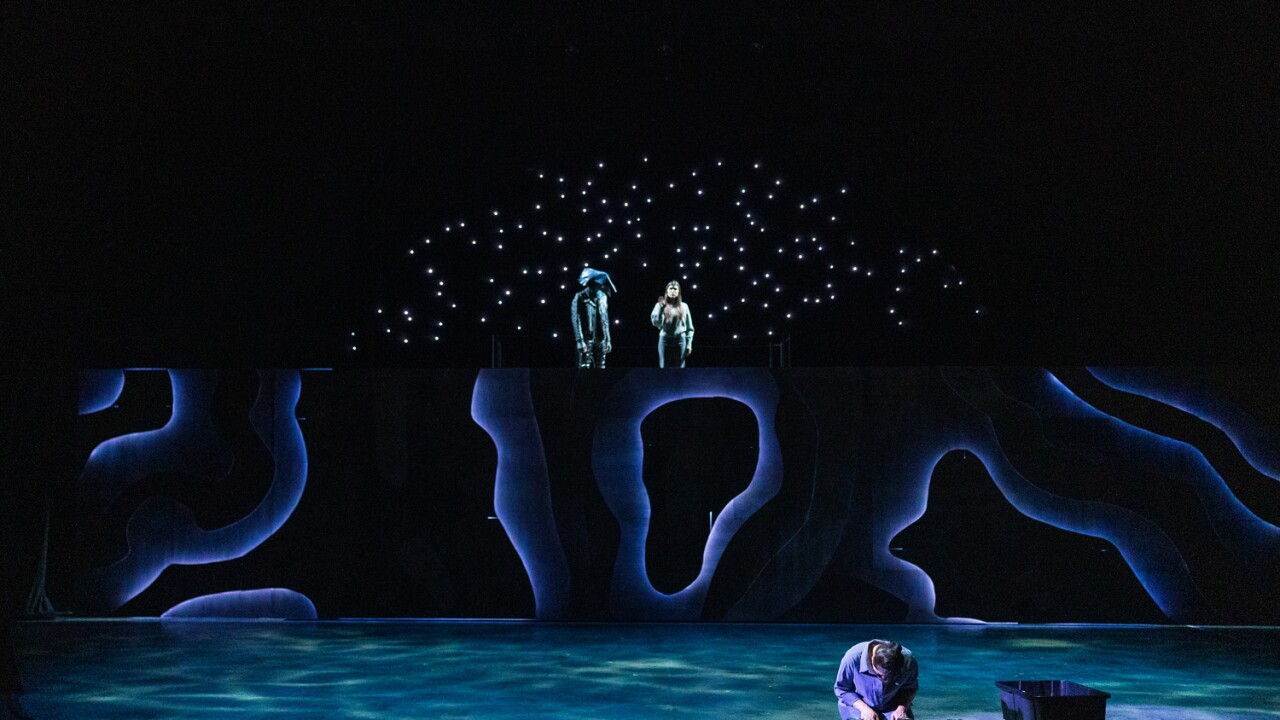

MISSOULA — When the genesis of “Can’t Drink Salt Water” came to playwright Kendra Mylnechuk Potter, the heady subject matter and intense responsibility of representing it made her hesitant to bring it into the world. But a series of serendipitous events convinced the University of Montana School of Theater and Dance alumna that the play needed to be written.
“The universe had plans,” said Mylnechuk Potter, a Missoula-based actress and writer. “It feels like this play has just done all of the work, and I’m just trying to stay out of its way.”
“Can’t Drink Salt Water” premieres at 7:30 p.m. Saturday, Feb. 14, on campus in the Montana Theatre. Evening and matinee performances run through Sunday, Feb. 22. Tickets are pick-what-you-pay, with a suggested ticket price of $35. Free tickets are available to any self-identifying Indigenous patrons by calling 406-243-6809 or emailing the box office at montanarepertorytheatre@gmail.com.
The story came to Mylnechuk Potter while teaching an online yoga class during the COVID-19 pandemic. With her mind open and relaxed, an image flickered: She saw a woman underwater with gills who knew there were people on dry land searching for her.
“I knew it was a play,” she said. “And I knew it was a Missing and Murdered Indigenous People project.”
MMIP refers to the crisis of American Indian and Alaska Native people being at a disproportionate risk of experiencing violence, murder or going missing. Indigenous people in Montana are four times more likely to be reported missing than their counterparts, according to a 2024 Montana Department of Justice report.
Mylnechuk Potter questioned whether she was the right person to write the play. She is a member of the Lummi Nation, whose ancestral lands extend throughout western Washington. She was adopted and raised by white parents near Portland, connecting later in life with her birth mother, other members of her birth family and her tribe.
But the same day Mylnechuk Potter had her visualization, fate intervened when she opened her laptop and read a newsletter from UM’s Montana Repertory Theatre. At the bottom was an announcement that they were commissioning a new production by an Indigenous playwright, ideally someone with ties to Montana and possibly exploring MMIP issues.
Mylnechuk Potter got to writing, submitted the proposal, was selected as a finalist and ultimately received the commission. The story was chosen by a nationwide team of Indigenous artists, including Oscar-nominated actress and UM alumna Lily Gladstone.
In the nearly six years since, that dream has launched a flurry of collaboration between Mylnechuk Potter, other working theater professionals, UM students and faculty, and Indigenous community members working together to workshop the play. It’s gone through two intensive workshops and has implemented feedback from cultural consultant Carissa Heavy Runner, an MMIP activist.
The finalized production showcases professional Indigenous talent from across the country, including cast members, set designers and more.
“The types of artists who are collaborating on this project are the kinds of artists that I would have fantasized working with if I still lived in New York,” Mylnechuk Potter said. “But they're coming here, which is even better.”
The experienced professionals work alongside paid UM student cast members, crew and designers as well, facilitating elevated learning and mentorship opportunities that most other university students wouldn’t receive until after graduation, said Montana Repertory Theatre Artistic Director Michael Legg.
The professionals involved in “Can’t Drink Salt Water” are expected to play an active role in students’ education, spending time with UM pupils and offering workshops, talks or Q&As while they’re in Missoula.
“The University is offering opportunities for not just theater students, but also dance students, music students and arts students who’ve come on board to help with projects and partner them with these incredible artists that we’re bringing in from all over the country,” Legg said. “That can help them take the next step in their career, and that’s really rare.”
Those opportunities are at the heart of the Montana Repertory Theatre’s purpose, standing at the cross-section of educational and professional theatre.
The rep is unique in that it largely showcases contemporary works and commissioned plays that push the edge of modern theater. The play received a significant grant from the Roy Cockrum Foundation to fully cover the cost of production and pay everyone involved. The foundation awards grants to support world-class performing arts projects in nonprofit professional theatres throughout the U.S.
New productions are something most college students don’t ever get a chance to experience, Legg said. But knowing how to work on new plays is one of the most valuable skills for a young theater professional going out into the world.
“Figuring out how to come into a room, collaborate with a group of people and all be in service to the play, and to try to make that play be the best version of itself is a rare skill,” Legg said. “It's just not taught in most universities, and we’re trying to give our students here a skillset that can be the thing that helps them get a job when they leave this place.”
Senior acting major Shadie Wallette is one UM student reaping those opportunities. Wallette, who hails from Billings and is an enrolled member of the Northern Cheyenne Tribe, is cast as a character named Star.
Wallette has been involved in the play since reading for Star during the second workshop in 2023. They connected with Mylnechuk Potter at the time and developed a close mentor relationship since.
“She took me under her wing,” Wallette said. “She gave me a ton of advice, and it was just so nice to see another accomplished Native person already established and out there.”
Portraying the role has been an intense learning experience for Wallette, who said they closely relate to Star. In playing the part, they are discovering how to separate themself from the character while also drawing on their own experience and identity to inform the performance.
“Playing this role of a Native woman who is so much like me, it’s going to be difficult to separate me and the character," Wallette said. “Star is also so passionate about her culture and things that are destroying it, and so having these motivators – I can understand as well.”
As rehearsals for the finalized production approached, Wallette was nervous to embark on their first paid, professional acting role as a young undergraduate, but excited to learn and grow.
“This is my first big job, and I’m definitely going to be one of the least knowledgeable people there,” Wallette said. “But, you know, that’s good. You want to surround yourself with people who know more than you so that you can learn from them.
“I can only just imagine the amount of mentoring I can get through this project because there’s going to be some Equity actors,” they added, referencing the professional Actor’s Equity Association union that represents workers in live theatrical performance.
Wallette said they are looking forward to making mistakes in a safe, supportive environment and learning under the tutelage of those mentors – especially given the unique opportunity of being part of a predominantly Indigenous cast and crew. Often, they’ve been the only Indigenous actor in a production.
Bringing a unique production like this to life is both exciting and meaningful – especially in Montana, they said.
“This story is so important to be told,” said Wallette. “Montana has such a high amount of Native Americans and Indigenous peoples, and there’s also an insane amount of missing and murdered Indigenous peoples.
“It breaks my heart every time I see another kid has gone missing or that another person has been killed for absolutely no reason other than the color of their skin.”
Wallette said they hope audiences leave the production understanding that MMIP is an epidemic that warrants attention and action, and that attendees understand just a little bit of what Indigenous victims and their loved ones go through.
While the play contains serious themes like grief, the unique production also weaves in moments of humor and fourth-wall-breaking calls to action.
Mylnechuk Potter hopes those calls to action compel audiences to participate in ending the MMIP crisis. Thinking about the play’s future, she imagines a better world someday where “Can’t Drink Salt Water” is seen as a period piece representative of a bygone travesty.
“My hope is that we are literally turning lights on and highlighting this issue,” Mylnechuk Potter said. “The fact that this play is getting a production of the caliber that it’s getting – with the kind of support that it’s getting – on my home stage . . . it feels like a dream I wouldn't have known to wish for.”
