

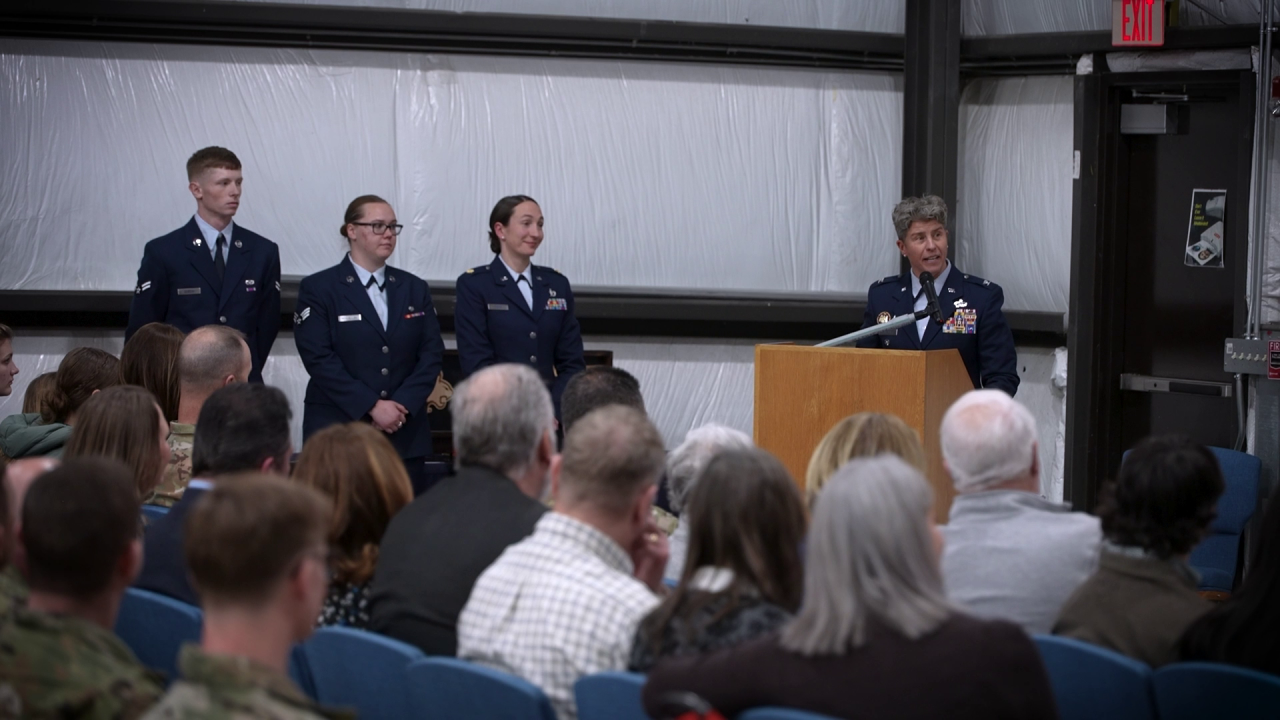


MALMSTROM AIR FORCE BASE — The Montana Air National Guard’s 219th Rapid Engineer Deployable Heavy Operational Repair Squadron Engineers, commonly known as RED HORSE, hosted a change of command ceremony on January 10th at Malmstrom Air Force Base.
During the ceremony, Colonel Jen Cinq-Mars formally assumed command of the 219th RED HORSE Squadron, becoming the first woman to lead the unit. The event followed a long-standing military tradition that symbolizes continuity of leadership and the unit’s readiness to carry out its mission.
WATCH COVEAGE HERE:
Col. Todd Mortag, the outgoing commander, said the ceremony reflects both gratitude and trust within the squadron.
“For me, as an outgoing commander, it’s an opportunity to thank the squadron and appreciate all the hard work that individuals have done,” Mortag said. “For the incoming commander, it’s important for the squadron to hear the new commander’s vision and the direction they want to take the unit.”

RED HORSE is an expeditionary engineering unit that provides rapid, deployable heavy construction and infrastructure support for disaster response, humanitarian missions, and federal contingency operations. Its airmen are trained to operate in austere or damaged environments, making the squadron a critical asset for Montana and national missions alike.
As Cinq-Mars takes command, she does so during a period of growth and increased operational tempo for the unit.
“We’re in a period of growth as far as our airmen, not only in their upgrade training, but also in the sheer size of the squadron,” she said.
Cinq-Mars joined the Air Force in 2000 and was commissioned in 2001, spending her early career on active duty before transitioning to the Air National Guard. Over the course of a 25-year career, she has worked across multiple career fields, including force support, logistics, and maintenance, and has completed five deployments.
She says those varied experiences shaped her approach to leadership.
“I’ve had an amazing opportunity to work with teammates that I never would have otherwise met,” Cinq-Mars said. “The best part of my career has always been the people and the relationships.”
Much of her early background was in force support, which she credits with influencing how she leads today.

“Force support gave me a good foundation on how to care for airmen,” she said. “When you take care of people, that’s what really helps a team come together.”
Mortag said that focusing on people has been a key part of the squadron’s success in recent years. Under his leadership, the 219th RED HORSE Squadron expanded its force, advanced airman training, and supported both state emergencies and global operations.
“This squadron has performed outstanding duty in support of not only the state of Montana and domestic operations, but also globally,” Mortag said. “The airmen here have accomplished incredible things, and I’ve been privileged to simply be a part of it.”
As commander, Cinq-Mars says her immediate priorities center on trust, training, and readiness.
“Getting to know the airmen is number one, building that trust, and then continuing their training path so we can provide fully trained airmen for our state and national missions,” she said.
She also emphasized the unique role RED HORSE plays in emergency response.
“RED HORSE is immediate disaster response,” Cinq-Mars said. “From runway construction to horizontal construction, we can respond quickly when those needs arise.”

Both leaders highlighted the importance of support beyond the squadron itself. About 90 percent of RED HORSE airmen are traditional guardsmen, balancing military service with civilian careers.
“We couldn’t do this without the support of families and employers across Montana,” Cinq-Mars said. “That support makes everything possible.”
As the 219th RED HORSE Squadron moves forward under new leadership, Mortag reflected on the transition as both a professional milestone and a personal one.
“It’s humbling,” he said. “It makes you realize how much the relationships with the individuals of this squadron meant to me. I’m very appreciative of everything the airmen have accomplished.”
Leadership says the change of command represents both continuity and confidence, honoring the work done under previous leadership while setting the course for the squadron’s next chapter under Cinq-Mars.
