




HELENA — Earlier this month, Gov. Greg Gianforte was on hand to launch a campaign calling for Montana to move to a flat income tax. Now, advocates of that proposal are going across the state, to put their arguments before an audience.
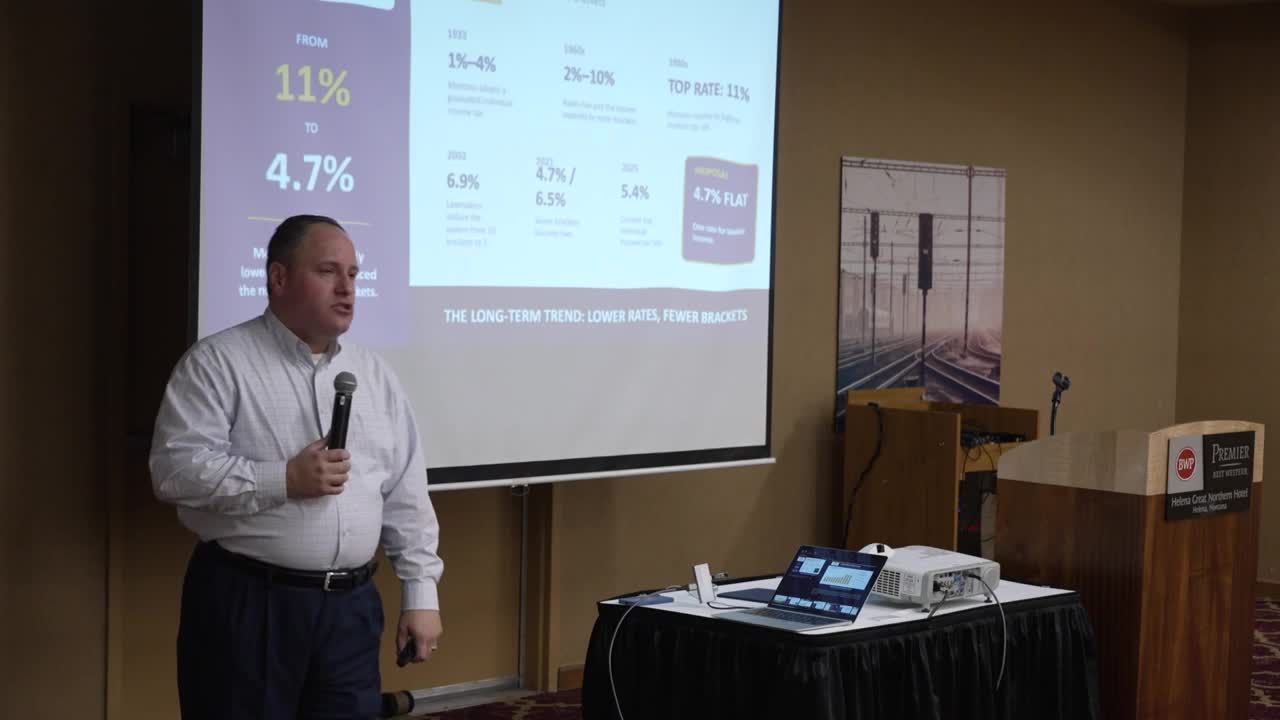
On Thursday, Mountain States Policy Center held a town hall in Helena, promoting its “Flat. Fair. Montana. Initiative.” President and CEO Chris Cargill says it’s the first of six scheduled around Montana over the next four months.
“We're out on the education trail, and making sure we go around to different communities and tell them all about it,” he said.
(Watch the video to see more from Thursday's event.)
Montana currently has two income tax brackets. In 2027, residents will pay 4.7% on their income up to a specific level – $65,000 for individuals and married people filing separately, $130,000 for couples filing jointly and $97,500 for heads of households. The rate will be 5.4% on any income above that.
Gianforte and MSPC have called for eliminating the top bracket and taxing all income at 4.7%.
“Whether you're living in Billings or Missoula, whether you're making $1 million a year or making $50,000 a year, everybody should pay the exact same rate,” Cargill said.
Cargill argues lowering income taxes is a needed step to keep Montana’s economy competitive with nearby states, many of which have lower top rates. He said the change could encourage businesses to create more jobs – especially small businesses, most of which are “pass-through businesses” whose owners report income on their personal tax returns rather than filing corporate taxes.
In its economic analysis of the flat tax proposal, MSPC estimated eliminating the top bracket would reduce state revenues by about $210 million, but that that budget impact could be reduced to around $192 million because of economic growth.
“I would suggest to you that over time, we will see that reduction go away, because the economic activity that this will spur, will spur more tax revenue for the state,” Cargill said.
After an initial presentation, Cargill answered questions from the audience, alongside Manish Bhatt, Gianforte’s tax policy advisor.

Among those with questions Thursday was Derik Reed, who told MTN he’s concerned this change would help wealthy Montanans more than others.
“I'm a retired teacher on a relatively fixed income,” he said. “Especially a flat tax – which is by its very nature regressive – I want to have an opportunity to hear what's going on and provide some input, if I can.”
Bhatt told Reed higher-income Montanans pay more taxes and would therefore receive more reductions in absolute terms, but there would be also benefits to other income levels.
“An impact is an impact,” he said. “A dollar that they can save that they didn't have to save before is a dollar they can save today, they can invest themselves, they can invest in their family, they can invest in their community. And so a flat tax is fair in that sense.”
Reed told MTN he appreciated the discussion, but he still had concerns.
“I think there's an opportunity to preserve especially the poor and the lower end of the middle class, who I don't think are going to be helped as much by flat taxes,” he said.

Other audience members asked whether the state could cut the flat rate even further. Bhatt said the Gianforte administration had sought to make previous tax cuts “responsible,” and that remained their goal with this plan.
“Responsible current reform is that 4.7%,” he said. “What a future Legislature does, what future revenues do, that's for a future time. For right now, 4.7% is a responsible number; it is a number that we're comfortable with.”
Cargill said Mountain States Policy Center is planning to hold more of these town halls, in cities like Missoula, Kalispell, Bozeman, Great Falls and Billings, leading up to the 2027 legislative session.
Republican leaders in the Montana Senate have already said they’re supportive of Gianforte’s proposal to adopt a flat tax during the next session. Legislative Democrats have spoken against it, saying it will create revenue shortfalls and benefit only high-earners.
