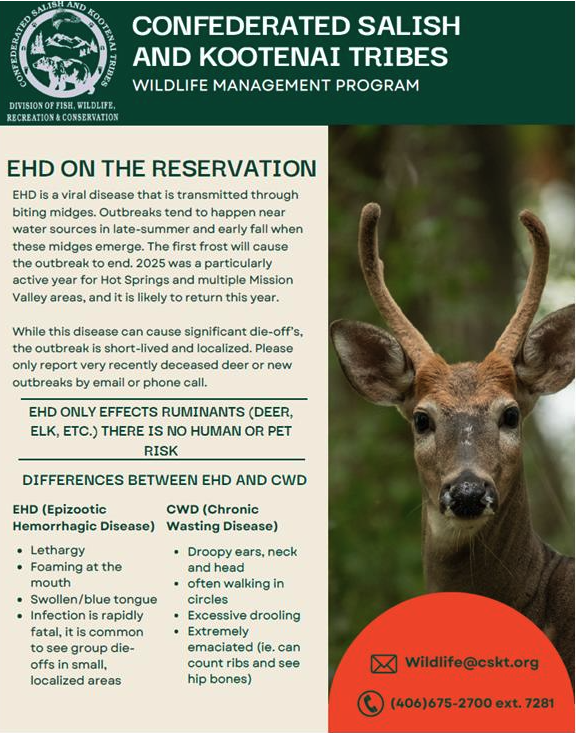
FLATHEAD INDIAN RESERVATION, Mont. — Hemorrhagic disease (EHD) has been confirmed as the cause of white-tailed deer deaths in areas surrounding Polson, Ronan, St. Ignatius, Hot Springs and Mission Valley on the Flathead Indian Reservation.
The CSKT Division of Fish, Wildlife, Recreation and Conservation is monitoring the situation. The disease is caused by biting midge flies and, while viral, is not contagious to humans. It can, however, affect deer and elk populations.
Outbreaks typically occur near water sources in late summer and early fall when certain small fly species emerge. The disease can persist in an area for 2-3 years after an initial outbreak but will likely subside after the first few frosts of the season.
While EHD can cause significant die-offs in localized deer populations, outbreaks are usually short-lived and not widespread. Affected areas are generally localized and not spread across large areas.
Residents in the affected areas do not need to report additional dead deer suspected of EHD. However, potential outbreaks observed in new areas of the Reservation should be reported by emailing Wildlife@cskt.org or by calling the Wildlife Conflict Call number at 406-275-2774.
Warning for hunters, anglers and recreators
Deer carcasses are concentrated around water sources and are attracting bears. Both grizzly and black bears are currently eating excessively to prepare for hibernation.
Anyone recreating in the area should carry bear spray and use extreme caution.
Hunting and food safety
Meat from animals that appear healthy at the time of harvest remains safe to eat when properly cooked. Hunters are encouraged to have any harvested animal tested for Chronic Wasting Disease.