

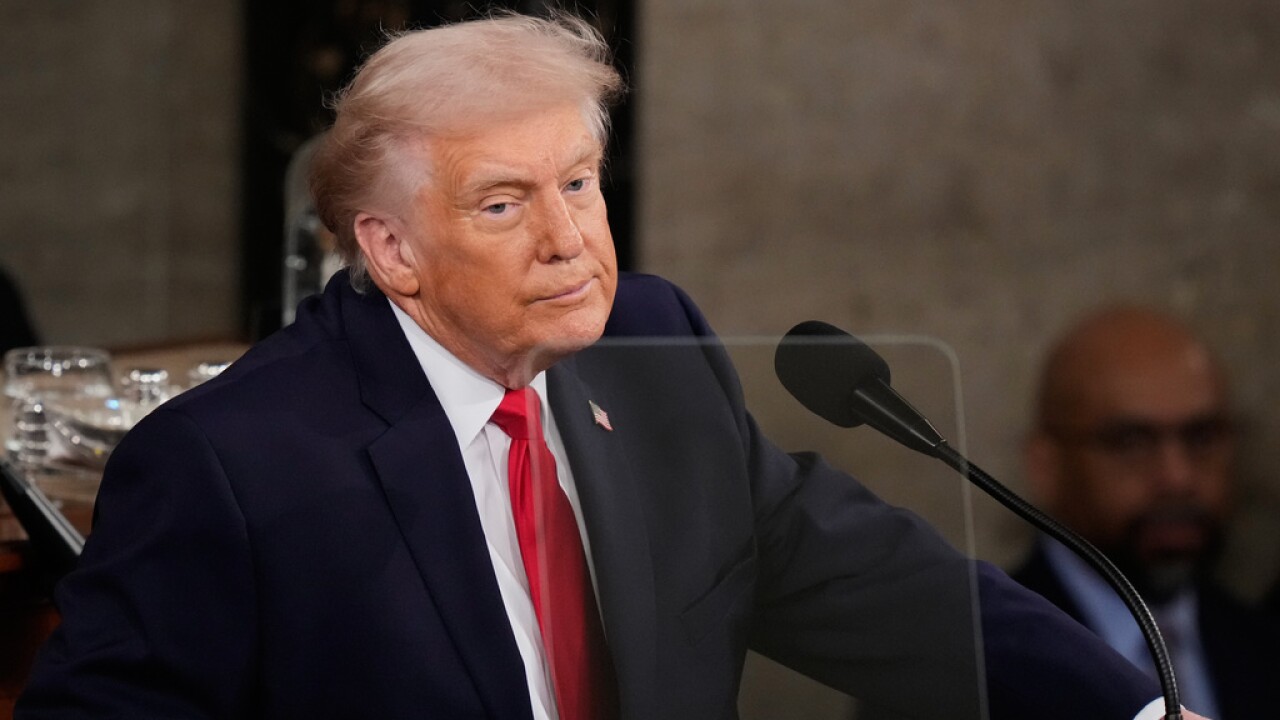

President Donald Trump plans to expand retirement savings, as the administration focuses on the economy.
The administration will match 401(k) contributions up to $1,000 a year for some workers without access to matching employment contributions, Trump suggested during his State of the Union address.
“To remedy this gross disparity, I am announcing that next year, my administration will give these often forgotten American workers, great people, the people that built our country, access to the same type of retirement plan offered to every federal worker,” Trump said.
The Savers Match Program, enacted under a law passed in the Biden administration, provides an annual match for low-income workers.
“It's something that can be stood up right away, and so, but in the end, the Savers Match Program, which was passed in 2022 and begins in 2027, needed to be completely revamped so that it would actually work," said Kevin Hassett, director of the National Economic Council. "And that's something that our team has been working on closely with Treasury. I think that all of us intend, in the fullness of time, to expand that program so that it affects everybody the President talked about."
Trump’s plan would provide an “account vehicle” for workers to receive the match, according to a White House official, who contends it will help build wealth for Americans saving for retirement. The administration is working to launch a new structure to make sure workers can take advantage of accounts, including through job changes, according to the official.
More than 55 million workers would be eligible, the official estimates.
“The goal is to make sure that when people earn their own money, that they're able to keep more of it. And we've seen that real wages have gone up,” said Labor Secretary Lori Chavez-DeRemer.
The announcement comes as the Trump administration has touted what it views as positive economic signals, including highlighting inflation, wages and jobs.
“I think it's been clear the president has delivered on the promises that he said he would make to the American people who elected him," Chavez-DeRemer said. "We've done some tremendous amount of work, and now, we're going to continue to double down and answer the call."
January saw the addition of 130,000 jobs and an unemployment rate that fell to 4.2%, according to the Labor Department. It included more healthcare jobs and an uptick in factory jobs after months of job losses.
“I think this is a testament to the president, promises made, promises kept. I'm going to go negotiate those contracts," said Chavez-DeRemer. "I'm going to go negotiate the investment into the country. Now we're going to go ahead and do the construction jobs we've seen gone up. Yes, we see it in healthcare. Yes, we see it in other places. But now you're going to start to see the manufacturing jobs come online."
Still, polling has shown many Americans remain concerned about the economy. About 70% of respondents said inflation and the cost of living have either not changed or gotten worse, according to a Scripps News/Talker Research Poll conducted ahead of the State of the Union address.
