

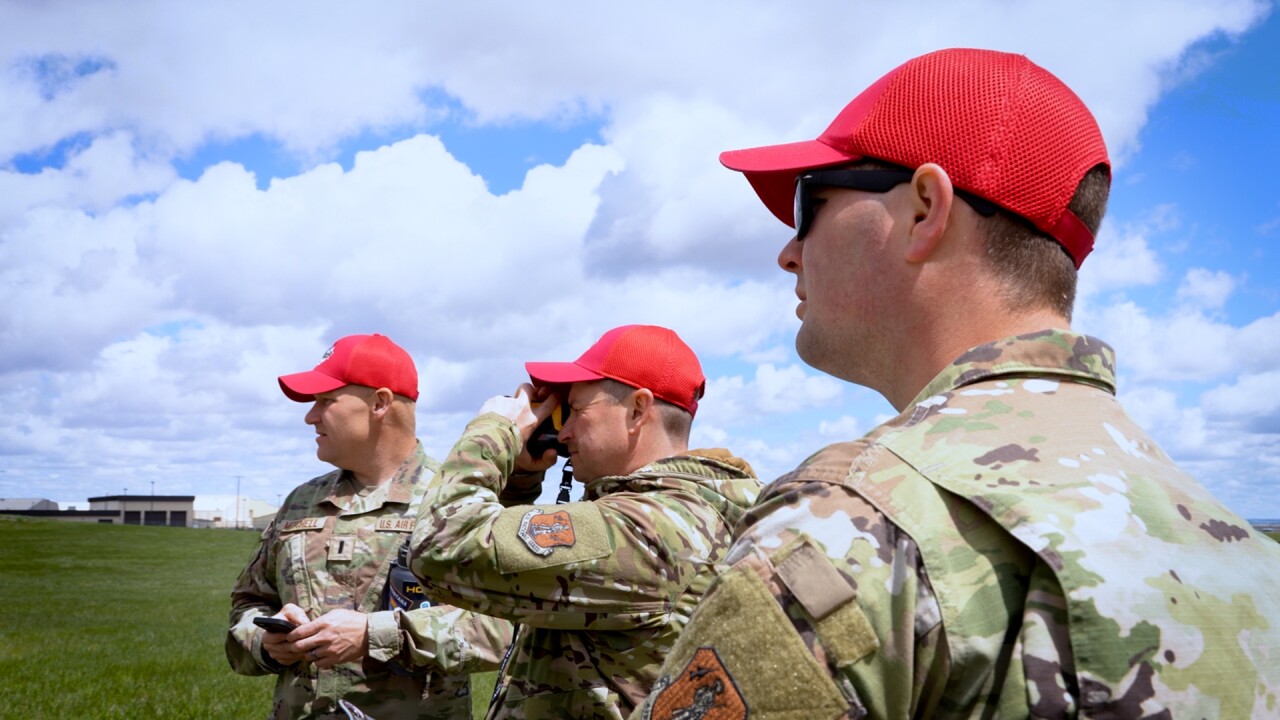


MALMSTROM AIR FORCE BASE — Around one month after the Montana Air National Guard unveiled the new Vigilante Drop Zone near Power, members of the 219th RED HORSE Squadron are now building on that capability by learning how to survey and certify landing zones themselves.
Madison Collier reports - watch the video here:
The training is part of a two-week Marine Survey and Assault Zone Assessment (MSAAZA) course hosted with the Montana Air National Guard on Malmstrom Air Force Base.
The course brings together members of the 219th RED HORSE Squadron, Marines from Marine Aviation Weapons and Tactics Squadron One (MAWTS-1), and Air Force personnel from the 123rd Contingency Response Group.
RED HORSE: Rapid Engineer Deployable Heavy Operational Repair Squadron Engineers
The goal is to train personnel to identify, survey, and assess areas that could be used for aircraft operations in expeditionary environments… places where traditional runways or established landing areas may not exist.
For the 219th RED HORSE Squadron, the course adds a new layer to their mission. RED HORSE units are primarily construction and engineering focused, which means members do not always get regular exposure to aircraft operations.

“Here in Montana, we just don’t get to work with aircraft very often,” said 1st Lt. Garth Mitchell with the 219th RED HORSE Squadron. Mitchell said the course gives the unit the ability to support those types of missions in-house, instead of relying solely on outside organizations to complete landing zone or drop zone surveys.
During the course, participants learn both in the classroom and in the field. The first week focuses on the fundamentals of different types of surveys, including landing zones, helicopter landing zones, and drop zones. Participants also learn how to calculate obstacle heights, complete required documentation, and build the reports needed for certification.
The second week focuses more heavily on evaluation, giving participants the chance to apply what they learned by conducting surveys in the field. Mitchell said that includes marking center points, testing soil strength, identifying obstacles, and determining the safest pathways in and out of a landing zone.
The training directly connects to the Vigilante Drop Zone near Power, which was surveyed and certified last year by members of the 123rd Contingency Response Group out of Louisville, Kentucky.
“We certified Vigilante Drop Zone around Power for the Montana Air National Guard,” said Master Sgt. Alexander Klosterman with the 123rd CRG. He said that work helped amplify Montana’s local training capabilities.

Klosterman said the survey process includes mission preparation, site assessment, and final production of the survey. Surveyors look for potential hazards, including obstacles that could affect aircraft safety, before the site can be used for training operations.
Now, instead of only bringing in outside teams to complete that process, members of the 219th RED HORSE Squadron are learning how to do that work themselves.
Mitchell said that matters not only for missions abroad, but also for Montana.
“That is a state desire or training requirement that we’ll be able to support in-house, which is huge,” Mitchell said. “This gives us the ability to do that for our home state, which is pretty awesome.”
Instructors say the course also strengthens interoperability between military branches. Gunnery Sgt. Jan Kamphauis, an instructor with MAWTS-1, said the training helps ensure Marines, Airmen, soldiers, and sailors can complete the same type of survey using the same standards.

“Gone are the days where we work in our own pockets of excellence,” Kamphauis said. “We need to get together and work together so that we all speak the same language.”
Kamphauis explained the skillset can be used in a wide range of missions, including crisis response, humanitarian operations, wildfire support, flooding response, and contingency missions in austere environments. He said the ability to survey smaller or unimproved airfields can help aircraft support missions in areas that may not have traditional infrastructure.
For Montana, the training represents a follow-up to the state’s growing aircraft training footprint. The Vigilante Drop Zone gave the Guard a new place to train. This course gives members of the 219th RED HORSE Squadron more of the ground-side knowledge needed to support those operations going forward.
