

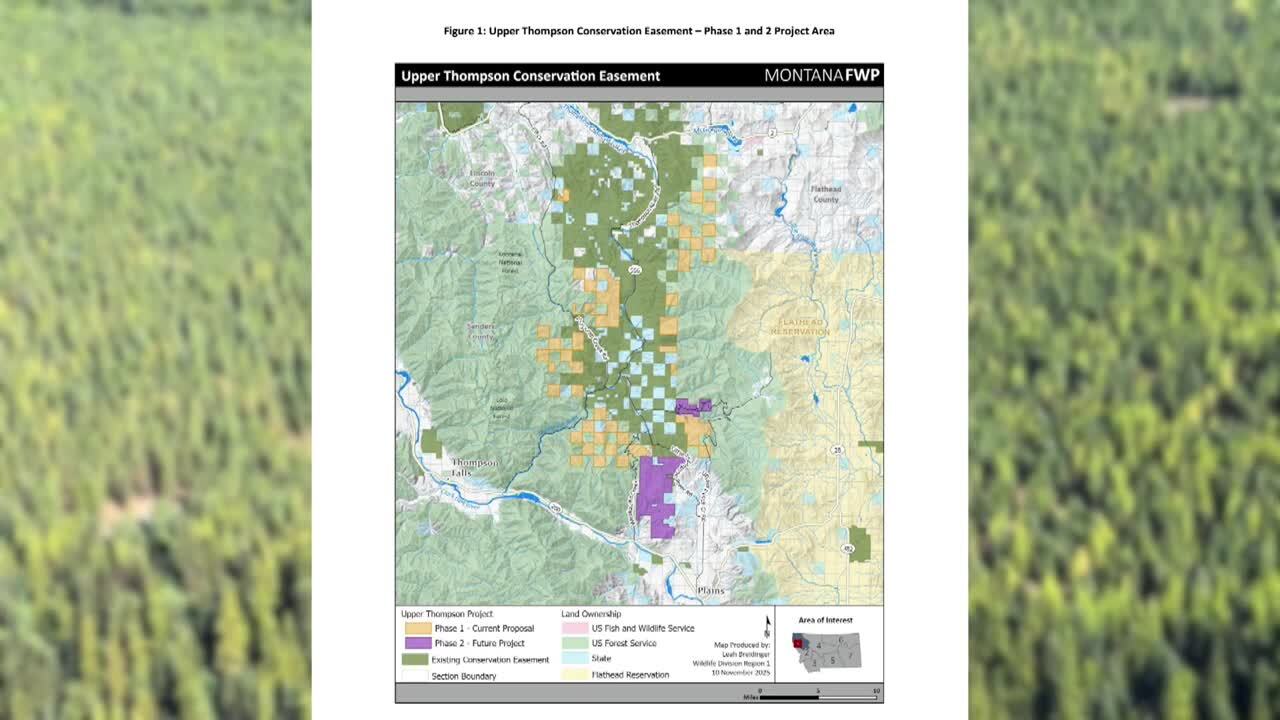


THOMPSON FALLS — In Northwest Montana, a plan is in the works to place tens of thousands of acres of the Thompson River drainage in the Cabinet Mountains in a conservation easement. Friday, the Fish and Game Commission will make a final decision on the project, which aims to set aside the land for generations of logging, recreation and wildlife.
(WATCH: A landscape look at the Upper Thompson Conservation Easement proposal)
“People really care a lot about this drainage, and they've been recreating there for generations, and this would secure public access forever,” said Leah Breidinger, a habitat conservation biologist with Montana Fish, Wildlife and Parks (FWP).
The Upper Thompson Conservation Easement proposes a partnership between Green Diamond Resource Company, a forest product company, and FWP, along with the Trust for Public Lands, to protect more than 34,600 acres north of Thompson Falls and Plains.
“There's a history in Northwest Montana of working forest and natural resource management and this is an easy step to that next generation of that legacy,” said Jason Callahan, a policy and communications manager with Green Diamond Resource Company.
This proposal is the first part of a two-phase easement project which, if it comes to fruition, would protect nearly 48,000 acres. These are final pieces of a massive string of Green Diamond easements, which they say will help steward what is left of Northwest Montana’s working forestland.
“Trip backwards to the turn of the millennium, there was about 1.2 million acres in Northwest Montana that was contiguous, private, working forest land,” Callahan said. “Fast forward to 2021, when Green Diamond bought that property, we're down to under 300,000 acres.”
The project is funded by the U.S. Forest Service’s Forest Legacy Program, which encourages protection of privately-owned forests through easements or land purchases in collaboration with state agencies.
If approved, the project would dissolve the property’s development rights and put the land in a conservation easement held by FWP, allowing Green Diamond to log and manage the forest. Callahan said this will stop the fragmentation of lands, while keeping it an accessible and working forest.
“Instead of having 10, 15, 20, 50-acre parcels being carved out, it stays intact as one solid, working land,” he said. “That allows us to keep producing forest products. It keeps loggers employed. It keeps fiber going to the mills.”
It would also guarantee that all the land will stay publicly accessible forever. Along with its importance for local recreation, the land is also key wildlife habitat.
“No matter who owns that land in the future, they can continue to access the property. It also contains just really important deer and elk habitat, particularly for our mule deer population. They really rely on these lands,” Breidinger said. “There's also important native fish habitat.”
Communities, local leaders and the wider public had input in the planning, through comment periods with FWP and meetings with Green Diamond and the Trust for Public Lands.
“It keeps working forests working, while also providing critical wildlife habitat,” Breidinger said. “Working lands really are an important part of the conservation puzzle in our area.”
Friday, the proposal will go before the Fish and Game Commission. If approved, the agreement will start this summer.
“This is a commitment by the state to keep this land open as working forest land, producing fiber, creating jobs, while at the same time conserving wildlife habitat and ensuring public recreational access and that is a win-win-win that comes about very rarely in this line of work,” Callahan said. “Whatever the next generation of Montanans like to do in the woods, this will be available to them.”
