


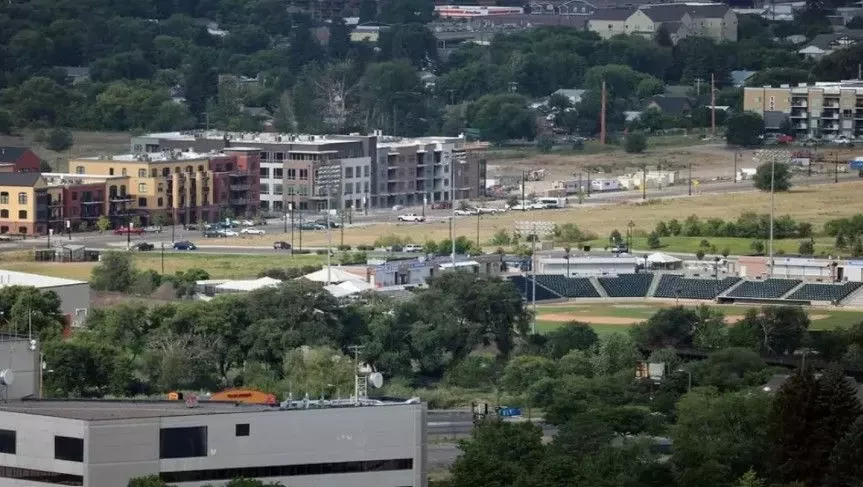
MISSOULA — More than 20 years after the opening of Ogren Park at Allegiance Field, the Missoula Paddleheads have won several Pioneer League championships, and while concerts have come and gone over the years, the stadium holds a storied chapter in the city's recent history.
But it's now poised for a new chapter. What form that will take remains uncertain.
Big Sky Professional Baseball and the City of Missoula are hashing out plans to replace the stadium's aging turf. As the owner, the city has offered to fund the field's replacement with new natural grass at a cost of roughly $1.6 million.
But Big Sky Professional Baseball wants to expand the field's use to year-round and has offered to cover the added cost of installing synthetic turf. Doing so would enable “rectangular” sports to use the field, and high-school and University of Montana baseball would also find a home.
“We'd have total versatility with the new facility,” said Matt Ellis, president of Big Sky Professional Baseball. “The more use we get in the facility, the more economic benefit we develop.”
The two options — natural turf versus synthetic turf — both present pros and cons, and it's up to the Missoula City Council to select a route. The Department of Parks and Recreation has a long history of maintaining natural turf, though officials have further vetted synthetic turf as an option.
“I feel comfortable as director in saying that the Missoula Paddleheads did a really good job in finding a quality product that is up to date and meets all the challenges for what we know today,” said Missoula Parks and Recreation Director Donna Gaukler. “It's a better product than we currently have at any of our other facilities that we have in town.”
The city installed a synthetic field at Fort Missoula Regional Park, which provides wide use during the shoulder seasons when the park's natural grass fields are soggy and unsafe. And while natural grass is better for the environment where plastics are concerned, Gaukler said synthetic turf doesn't require the ongoing water, maintenance, and fossil fuels that natural turf requires.
“Synthetic turf can take up the demands of four to seven natural turf fields,” Gaukler said. “If you think of Fort Missoula Regional Park, where we have 10 natural fields and one synthetic field, that one synthetic field, particularly in the spring, assumes the uses of all those other fields.”
But in July and August, the synthetic turf may warm more than natural turf, Gaukler said, adding that safety issues are mixed. Natural turf is preferred when it's perfectly maintained, she said, but that's difficult during certain seasons.
In those cases, Gaukler said the synthetic turf becomes the safer option.
“I think the question comes down to forever plastics and products,” she said. “It's whether we can sufficiently mitigate that with all the things the Paddleheads have committed to doing, and then really up our use of an existing (stadium) facility so payback and public access balances or exceeds the challenges.”
Benefits of a synthetic field
Last year, Ellis said the stadium drew 91,000 users and hosted more than 100 events over six months. Installing synthetic turf would expand the field's use, with the greatest opportunities coming during the shoulder seasons in spring and fall.
“You, as a city, have done an amazing thing with this whole park. It's been a great investment, and we want to make it better,” Ellis said. “There is a capacity to do more if we can expand our shoulder seasons.”
A synthetic field would present a wider array of options, Ellis said. That would include expanded field use, such as soccer and other “rectangular” sports. Montana also launched a high-school baseball program, but few teams in Missoula have an adequate place to play.
“We've been a big supporter of the high-school baseball community, but they need fields,” Ellis said. “We can't support them fully in March and April due to the conditions of natural grass. They can't play all their games. The field would be hard to keep at a high level and injury-free.”
But with a synthetic field, Ellis said Big Sky Professional Baseball could support all local high-school home games. He said the interest is there, and the University of Montana baseball club is also looking for a home.
Ellis said the synthetic field would be designed for expanded use, including base plugs for softball and Little League. It would also have a removable pitching mound, freeing space for rectangular activities.
“With the clay mound that we have, it really limits our ability to do rectangular sports on natural grass, because we can't scrape the mound,” he said. “The city controls the narrative. You control where, what and how. We have an opportunity to do it right, meet our community needs and do it responsibly.”
Vocal opposition
In vetting a possible synthetic field, Big Sky Professional Baseball landed on Target Sports, largely given its reputation. The company has completed a number of high-level synthetic fields, including the University of Montana's softball field. It also laid the field at Gillette Stadium (home of the New England Patriots), along with fields at the University of Oregon and Cal.
While the two options present pros and cons, a new lobby group has formed in Missoula to stop the synthetic option. In a letter to the city, the local chapter of Families for a Livable Climate called the synthetic option “disturbing.”
Members of Plastic Free Missoula have also weighed in, voicing opposition to the synthetic option.
“I've been very impressed with Missoula's commitment to reduce its pollution load, especially as its population grows,” said Vickie Watson. “But in one area, I feel Missoula has been going in the wrong direction, and that's in the increased use of plastic turf in playing fields and parks. The huge carbon footprint, water footprint and toxic load from plastic turf runs counter to Missoula's commitment to reduce all of these.”
While natural grass also requires care, Watson said plastic turf “is in a different league.” Others agreed, saying the unknowns around synthetic turf are similar to asbestos years ago.
“I understand you have to weigh needs and challenges,” one woman told the City Council. “But this issue of health concerns of plastics have not been fairly addressed.”
