

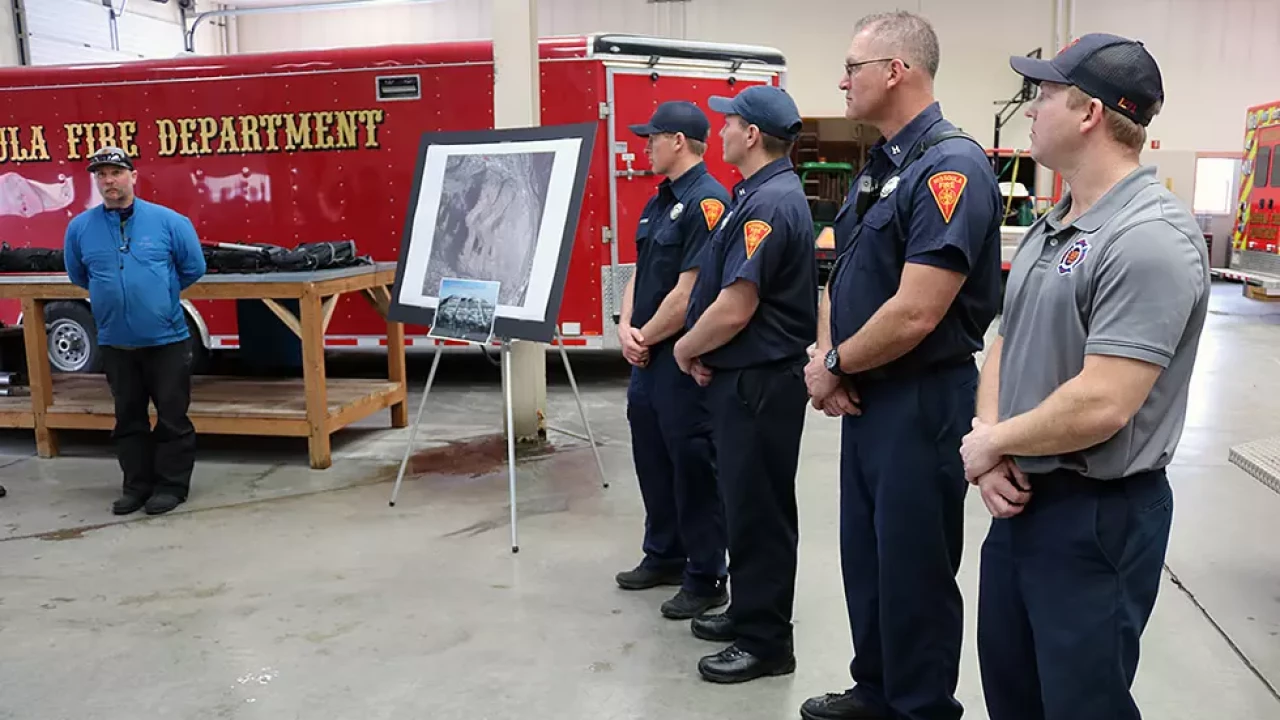

MISSOULA — Kevin Straub moved home to Montana and applied to work for the Missoula Fire Department in 2010. He had already been a career firefighter for seven years in Gallatin County and eight years in Missouri, but he didn’t make Missoula’s cut.
It wasn’t for lack of ability. Rather, it was because of his Polson address: Straub lived too far outside of Missoula’s firefighter residency requirement to be considered. He couldn’t just move to Missoula – his wife was a physician in Polson and had to adhere to the hospital’s policy of living within 20 minutes of the medical center.
“I was trying to stay in the career of being a paid firefighter, and unfortunately, I wasn’t able to get on because of the residential requirements,” he said.
Thanks to a recent amendment passed by the Missoula City Council, people like Straub who live outside of Missoula will be eligible to be on the city’s fire team.
The Missoula Fire Department will allow firefighters to live farther from city limits in hopes of giving staff more lifestyle flexibility and improving recruitment.
Missoula’s firefighters have been required to live within a 45-minute drive of Missoula city limits. Starting Nov. 5, firefighters will be able to live 60 road miles from the fire station nearest to them, measured using Google Maps.
Missoula Fire Chief Lonnie Rash said the change is primarily driven by the fire team wanting more lifestyle flexibility. Although the cost of housing has gone up more in Missoula than in other parts of the state, according to the 2025 Five Valleys Housing Report, Rash said lifestyle freedom is the primary driver.
“If they want to have some horses or other animals, that’s the number one driver,” he said.
Although Missoula does not have a recruitment shortage now, part of the reason for the expansion is to attract more talent.
“We have a small area where we can recruit from,” Rash said. “This gives us the opportunity to recruit from a larger [area] and increase diversity in terms of us [being] able to get into the Polson, Ronan areas as well. It just expands that zone.”
The biggest concern from the Missoula City Council centers around callbacks, the process of bringing off-duty firefighters back to a fire station during major events that require more hands on deck.
Firefighters residing within 30 minutes of city limits are called back first, and if more people are needed, all firefighters get called back.
According to the most recent data from the Missoula Fire Department, 90% of Missoula’s 131 full-time firefighters live within 15 minutes of Missoula city limits. Seven and a half percent live 15-30 minutes away, and only 2.5% live 30-45 minutes away.
The callback process is the reason why Missoula has a residency requirement when many fire departments in the Mountain West do not. The relatively small staff for the city’s size means calling back firefighters is an important part of how Missoula’s fire response operates.
Rash doesn’t foresee fulfilling callbacks being a problem, even if more firefighters start living farther away.
Under the current policy, firefighters are not required to respond to callback requests. Still, 98.3% of the 29 callbacks last year were completely filled, and the calls that weren’t fully filled still got responses.
The residency expansion is good for the rural volunteer fire department territories the new boundaries dip into, too.
Tayler Hayes commutes about 40 minutes to his career lieutenant firefighter position in Big Fork and spends his days off as a lieutenant with the volunteer fire department in his hometown of Polson.
Hayes said that it’s not uncommon for paid firefighters to also volunteer in rural communities.
“I wouldn't be fulfilling my responsibilities as a firefighter as a whole by not volunteering with the department here,” he said. "The reason why people are firefighters is because we love our jobs. If I have free time, and I live in a space where they need volunteers, then it just makes sense for me to be a volunteer.”
When Straub wasn’t eligible for the Missoula Fire Department, he joined Polson’s volunteer department. After many years as a volunteer, he got a paid position as the assistant chief.
Straub said that if the residency requirement hadn’t been an issue and he had been admitted to the Missoula Fire Department, there would be no question that he would still have volunteered in Polson.
“I love to give back to my community,” he said. “Most of my volunteers, the one thing they say is that they want to help their community, and that’s what I would have done. I’m confident I would have been a volunteer anyway.”
Straub believes Missoula's residency change can only be a good thing for rural volunteer fire departments and said "there are no negatives, all positives” to having more trained firefighters in rural communities.
Although the change will be implemented in November of 2025, the full impact of recruitment will likely not be felt until the 2026 recruitment season begins next fall.
