

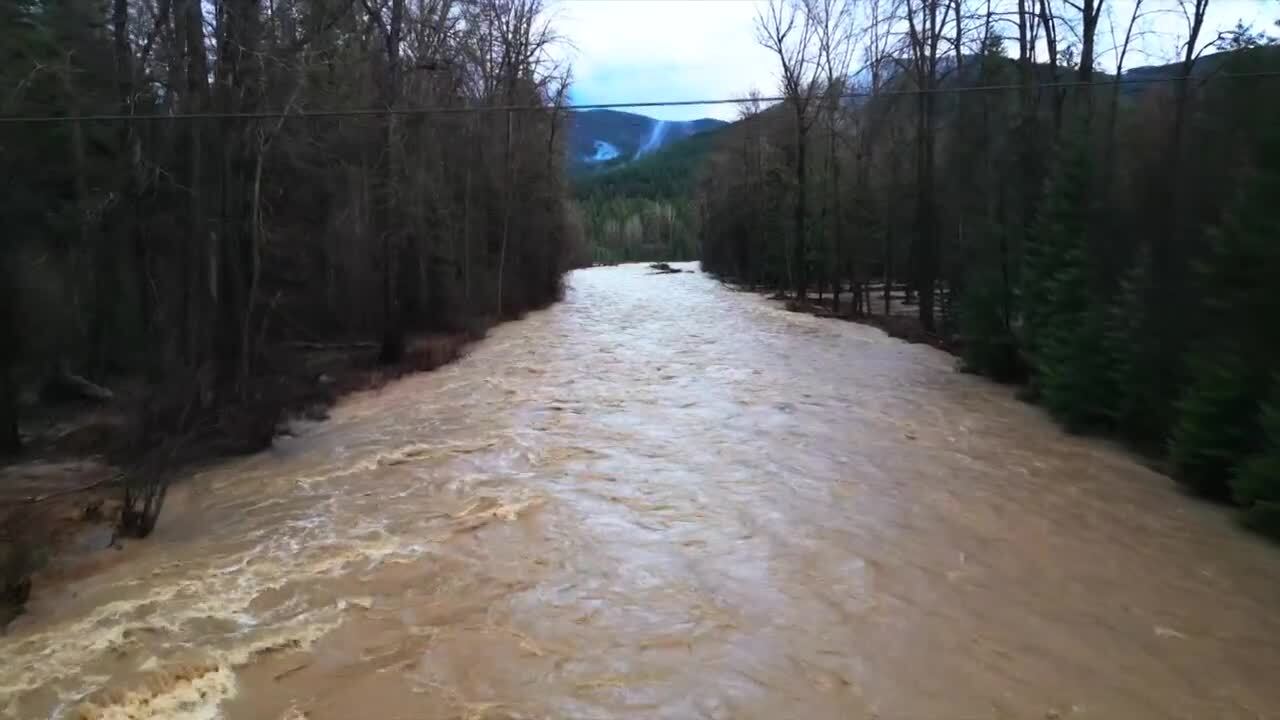

A deluge of precipitation combined with unseasonably warm temperatures this week generated record-breaking streamflows on Thursday along Libby Creek and the Yaak and Fisher rivers in Montana’s northwesternmost county.
In addition to flooding buildings along the southern end of Libby and washing away roads and bridges, the flooding has generated concerns about drinking water supplies and the release of historic vermiculite and asbestos mining waste.
On local social media accounts, residents questioned whether the floods might spread toxic soil from the local Superfund site and whether drinking water sources had been compromised.
We asked environmental officials to address these questions and explain how flooding could impact lingering asbestos contamination. The short answer: there does not seem to be any need for immediate alarm about contamination, government experts said, but residents should continue to boil their water and may encounter pieces of vermiculite after flood waters recede. Here’s what else we learned.
But first, what is asbestos again?
Asbestos is a naturally occurring byproduct of vermiculite ore. However, the unleashed particles can be toxic if inhaled, contributing to various lung diseases and cancers. The discovery of the area’s asbestos contamination — stemming from the nearby vermiculite mine formerly operated by W.R. Grace — led officials with the U.S. Environmental Protection Agency to establish a wide-ranging Superfund site in 2002 and issue a public health emergency in 2009.
Many of the Superfund sites’ areas, known as “operable units,” have been remediated through soil removal and containment and removed from the federal government’s list of priority sites. However, asbestos fibers do still linger in areas of land that were never previously identified or considered urgent for remediation.
Where is the flooding happening relative to the Superfund site?
According to public health officials and emergency responders mapping infrastructure outages in Lincoln County, most of the flooding has occurred south of the towns of Libby and Troy. However, some of the flooding along the Highway 2 corridor has overlapped with the area’s Superfund site boundary, the southern edge of which stretches roughly 10 miles south until just before the Elliot Creek junction with the Libby Creek.
The now-closed vermiculite mine is roughly seven miles northeast of the town of Libby, on the other side of the Kootenai River from where most of the dramatic flooding occurred.
Melody Kraayeveld, a state Department of Environmental Quality program officer who oversees the Libby Asbestos site, said her agency has been in touch with representatives from Grace, which still owns the shuttered mining location, about potential flooding impacts. She said the company has been doing daily inspections at the mine, as well as the impoundment dam site near Rainy Creek, and that W.R. Grace representatives have told her they have “no concerns” about its integrity due in part to the fact that the northern portion of the Kootenai basin hasn’t seen as much precipitation and flooding as the area south of the Kootenai River.
Montana Free Press reached out to W.R. Grace for additional information on the mine, which closed in 1990. The company did not immediately respond to MTFP’s interview request.
A spokesperson for the EPA, which still oversees the remediation of the area that includes the vermiculite mine, said in an email Friday that the federal agency is not aware “of any impacts to the Libby Superfund site regarding flooding.”
So, what are environmental regulators concerned about?
Kraayeveld said she’s primarily concerned about the flooding mobilizing vermiculite in areas with mine waste that were previously unknown to the department.
Since asbestos fibers are typically a risk when airborne, flooding isn’t likely to result in immediate, acute health risks for local residents, Kraayeveld said. However, the flooding could unearth vermiculite that previously wasn’t visible, she added. The newly relocated vermiculite can then dry out and present an exposure risk.
“As those waters recede, we’ll be going out and doing some inspections and ensuring that those areas [where mine waste may have been placed in the past] are still safe,” she said. “If we do see any evidence of mine waste, we’ll be going in and doing additional work at that time.”
Kraayeveld advised residents who find vermiculite — which she described as visually similar to mica, “kind of shiny” — to get in contact with the Lincoln County Asbestos Resource Program, which can remove it and take it to a secure portion of the Lincoln County Landfill dedicated to long-term vermiculite storage.
“We are anticipating working with the property owners that have impacted properties from the flooding, and we will probably be looking at doing additional inspections if they wish,” Kraayeveld said.
Is it safe for local residents to drink tap water?
The state DEQ on Thursday directed the city of Libby to issue an advisory to boil water used for drinking, cooking, brushing teeth or dishwashing until issues stemming from the flooding had resolved. A spokesperson for the department said the flood waters “have resulted in high turbidity” in the local water source, making it difficult for the city to treat the water as it typically does.
“The advisory will be in place until the water supply is able to consistently comply with the Safe Drinking Water Act’s surface water treatment requirements,” said DEQ spokesperson Nolan Lister in a Friday email to MTFP.
Both DEQ and a local water treatment employee said the area’s drinking water source — Flower Creek — is not known to have been contaminated by asbestos from past mining activity.
Jonathan Graham, an operator at Libby’s water treatment plant, told MTFP on Friday that the boil order had nothing to do with asbestos contamination potentially impacted by recent flooding.
“It’s about completely other contaminants,” Graham said. “Where our water plant is, the stream that feeds our pond goes by a clay bank. When we get a storm run off like this, it erodes the clay bank … The water is just way too dirty to filter things out all the way.”
Graham said the contamination in the water peaked on Thursday at 114 NTUs, or Nephelometric Turbidity Units — the standard way to evaluate particulate concentration in moving water. By Friday, it had dropped to 27 NTUs, Graham said. However, the boil advisory may stay in place in the coming days in case more rainfall increases area flows, he said.
How should I get in touch with the asbestos resource program?
The Lincoln County Asbestos Resource Program can be reached by phone at 406-291-5335. Locals who have questions about vermiculite or asbestos exposure and removal can also fill out an inquiry form at the organization’s website.
This story was originally published by Montana Free Press at montanafreepress.org.
